Author’s Note:
I have another blog post that I’ve been working on–just something fun, but with all the recent events I feel strange posting a bunch of silly stuff right now. So, I’ve decided to wait on the first idea and post this instead.
“This” is a short piece I wrote for my expository writing class a little less than a year ago about my family’s experience visiting New York City in 2024, braided with the history of the Statue of Liberty and a family member’s immigration to the United States in the 1920s.
With all of the horrible things ICE is doing in our country right now, I thought I would share this piece again. Every person living in the United States is an immigrant. We all deserve to feel safe in our cities and our homes.We are all created equal. We are all people.
Final note–this is a creative non-fiction piece. It is loosely based on a family member’s immigration to the U.S., but I took a lot of creative liberty, as I do not have much information on the family member.
Pieces of Liberty
When the Statue of Liberty was completed, it had to be sent over in 350 individual pieces, packed in 214 crates. These pieces were shipped from France on the frigate Isère, finally arriving in New York Harbor on June 17, 1885. Unfortunately, the base for the statue had not been finished yet, and all of the pieces of Liberty sat, waiting, for another year until they would be put together again.
***
Before August of 2024, no one in my immediate family had ever been to New York City. Like everyone else who’s never been to New York City, all of our expectations were based on what we’d seen in movies and TV shows: shiny skyscrapers, lots of bagels, and maybe even meeting a celebrity. Technically, we weren’t even staying in the city; we had a hotel room in New Jersey. There are a few ways to get to New York City from New Jersey. You can drive there (which we did the first day), or you can take a ferry (which we did the third day). There are a lot of moving parts when you’re a family of seven trying to get everyone from New Jersey onto the ferry and to New York City all in one piece. It’s a lot easier to use a buddy system. We split into groups of two or three and found spots on the ferry. We sat, and we waited.
***
Somewhere in Poland, in the late 1920s, a young woman is about to board a ship to America. Her parents are already there, waiting for her. What were her expectations? Had she heard the myths about streets of gold? The American Dream? Maybe her parents had already told her what it was like. Mildred Bloom sits with the other passengers on the ship, and she waits.
***
We decided to take the ferry for a few reasons. One, because we were visiting my great uncle, and he likes the ferry. Two, this is how we would see the Statue of Liberty. Of course, it would be kind of far away, so we wouldn’t get to see it up close, but we’d still get to see it. I frequently get motion sickness, and unfortunately I left my non-drowsy motion sickness pills back at home. I only had the regular ones that made me sleepy. I decided I could tough it out. It’s not like we would be going over the real ocean. Rachel [my sister], who also gets motion sickness, decided to take one of my sleepy pills. “Don’t do that,” I tell her. She shrugs, and pops one in her mouth anyway. “You’re going to regret that,” I say.
***
Mildred Bloom was Jewish. Who knows why her family decided to move to America? This was Poland during the 1920s. Maybe they could already sense what would be coming in the next decade. Maybe they knew they should leave before it was too late. During the 1920s, almost 3 million Jews lived in Poland. By 1945, only about 300,000 would remain.
Mildred would not have had motion sickness pills.
***
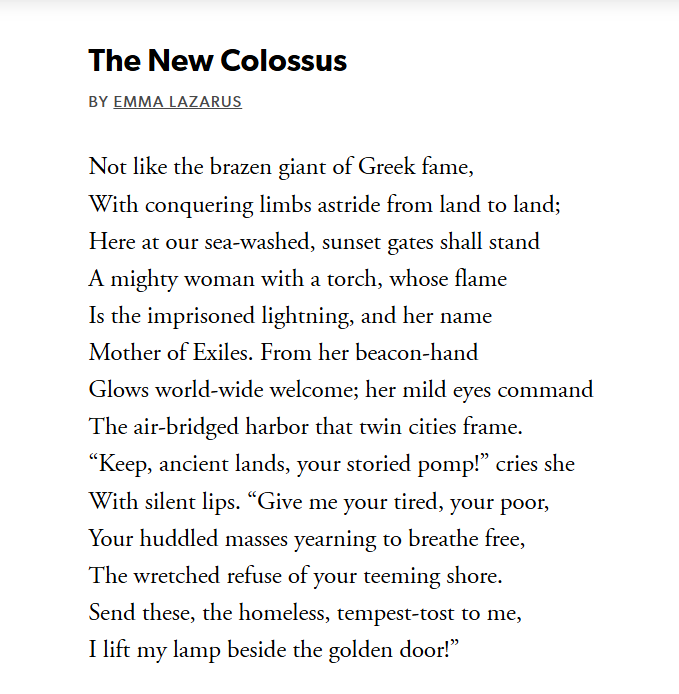
On October 28, 1886, the Statue of Liberty was officially unveiled and celebrated by thousands of spectators. But before that, in 1883, the United States was still attempting to raise funds to build the pedestal. One way that funds were raised was through auctions. Poet Emma Lazarus submitted her sonnet “The New Colossus” to an art and literary auction. In 1903, this poem was put on a plaque in the pedestal. The most famous line of this poem reads: “Give me your tired,
***
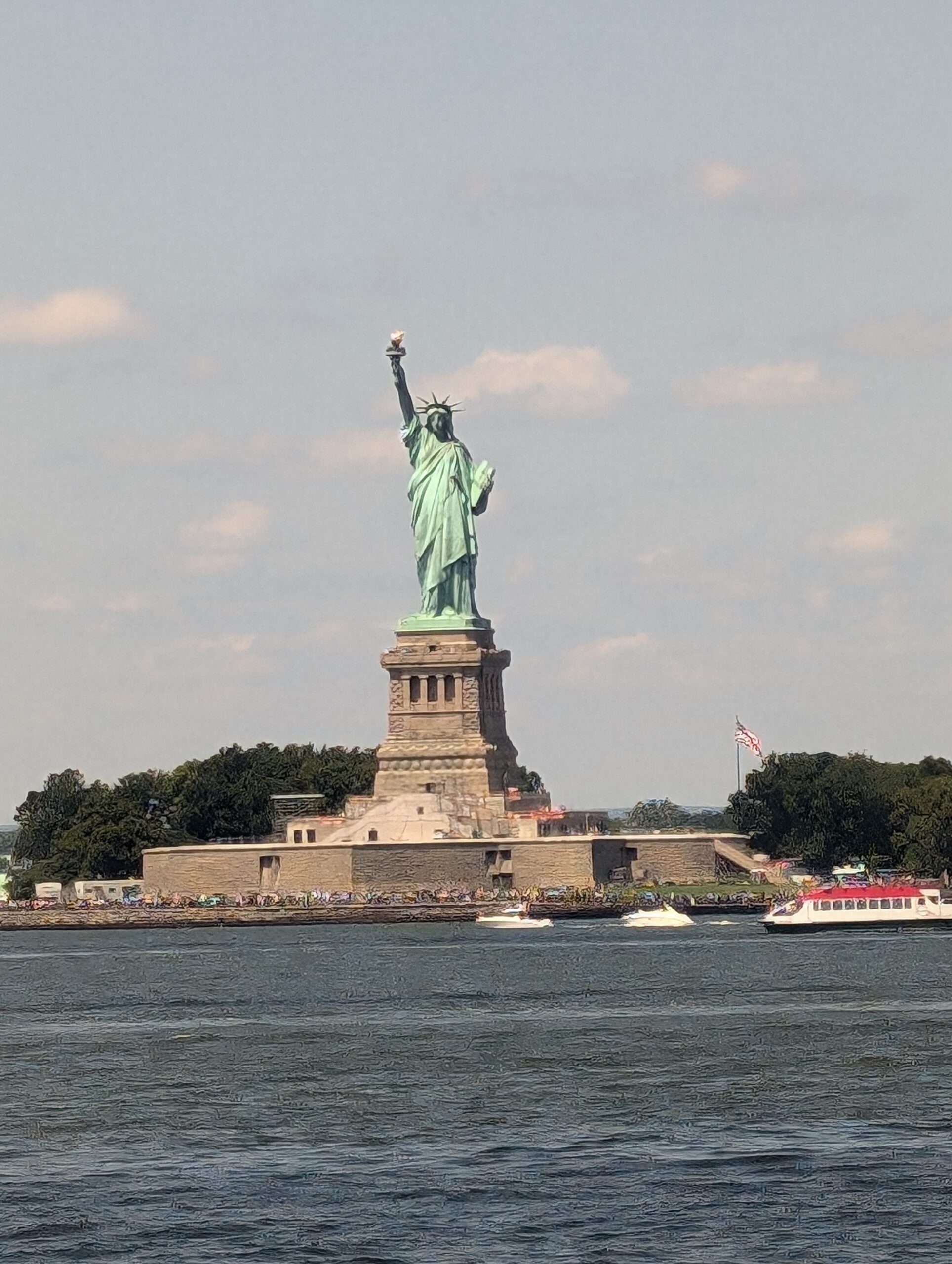
I look over at Rachel on the ferry. She is conked out, her head resting on the window. I smile. I knew this would happen. “Look,” I say, shaking her awake, “there’s the Statue of Liberty.” It’s small, a little green figure in the distance. I pull out my phone and zoom in. There is Liberty, holding up her golden flame, welcoming our little ferry.
***
your poor,
***
Also aboard the ferry are locals. For them, this is their commute to work. You can tell who the locals are by looking at who’s standing at the windows, zooming in with their cameras to catch the slightest glimpse of a green statue, and who’s sitting down on a bench, looking at a newspaper, or a phone, unbothered. The city isn’t all glitz and glamour. The city is also shadows, people doing whatever they can so they can survive just one more day.
***
your huddled masses yearning to breathe free.”
***
Sometime in the late 1920s, Mildred Bloom sees the Statue of Liberty as her ship approaches the city. When the boat docks, hundreds of passengers exit with her onto Ellis Island. In the next few years, Mildred will marry Leo Falk, another Jewish immigrant, and have two sons: my grandfather and my great uncle. But that’s later. For now, Mildred breathes.
***
About 100 years later, my family steps off the ferry and disappears into the crowd of 10 million people that day, breathing, in New York City.